

Load Center vs. Panelboard: What’s the Difference?
October 4, 2026Load centers and panelboards do much the same job: they distribute electrical power to individual circuits and accommodate overcurrent protection. The distinction matters when you are choosing equipment for a house, a retail space, or a larger commercial building. Two enclosures may look similar from the outside yet differ in their ratings, breaker arrangements, and installation options.
In North America, a load center is generally a type of panelboard, although the two terms are often used differently. Load centers are commonly found in residential electrical systems, while panelboards typically offer more configurations for commercial and industrial applications. When comparing products, it’s important to check their electrical ratings, circuit capacity, and breaker compatibility rather than relying on the product name alone.
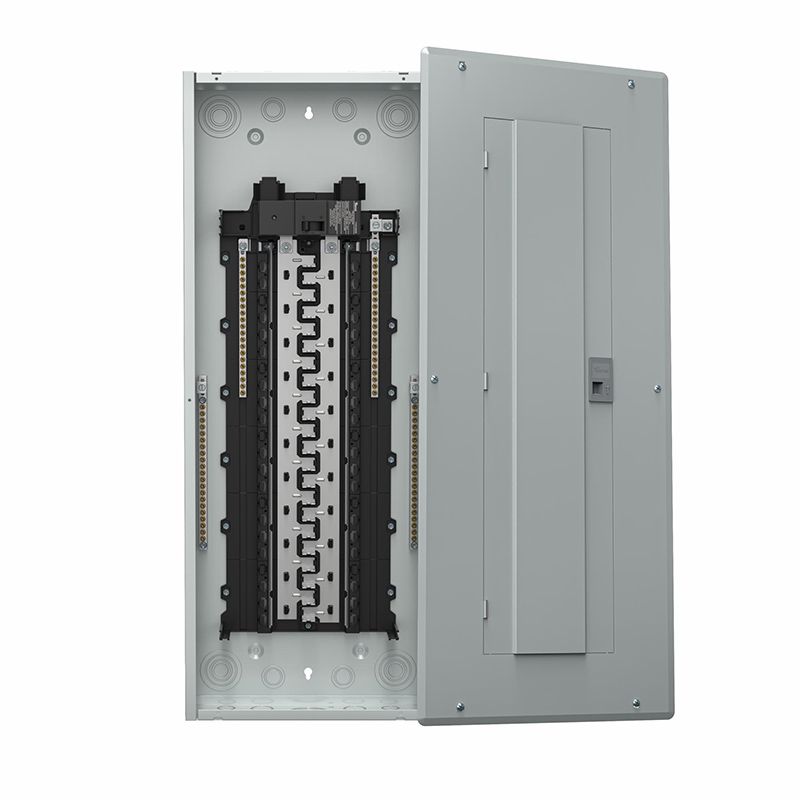
What is a load center?
A load center brings the bus bars, circuit-breaker mounting provisions, and incoming power connections into one enclosure. It is familiar equipment in single-family homes, apartments, and many light commercial installations. Depending on the model, it may be supplied with a main breaker or main lugs and may be intended for indoor or outdoor use.
Residential load centers typically serve lighting, receptacle, heating, cooling, and appliance circuits. Their compact construction and widely used breaker layouts make them a practical choice where the distribution requirements are relatively straightforward. Available ratings and breaker options vary by manufacturer and series, so the catalogue and equipment label should govern the final choice.
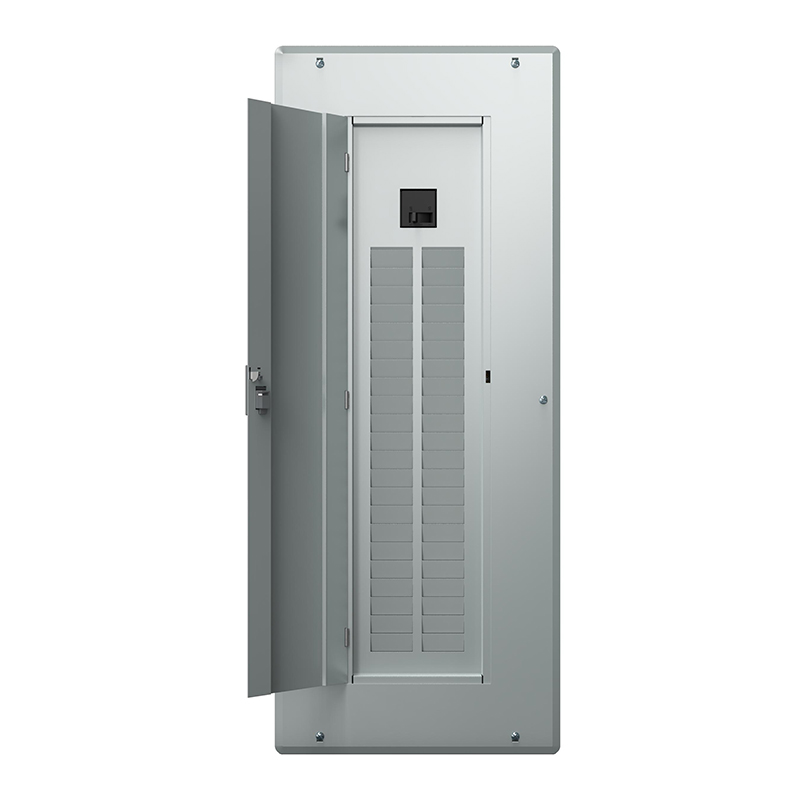
What is a panelboard?
Panelboards also distribute power to branch circuits, but commercial and industrial product lines often provide more choices in bus ratings, protective devices, metering, and circuit arrangements. They are common in offices, schools, healthcare facilities, industrial buildings, and larger multi-unit properties. Some panelboards use bolt-on breakers; others accept plug-in devices. Neither connection style should be assumed without consulting the manufacturer’s approved breaker list.
The term “panelboard” is not restricted to high-voltage or industrial systems. A particular assembly may be suitable for residential or light commercial work as well. What matters is whether its electrical ratings, construction, and listing suit the installation.
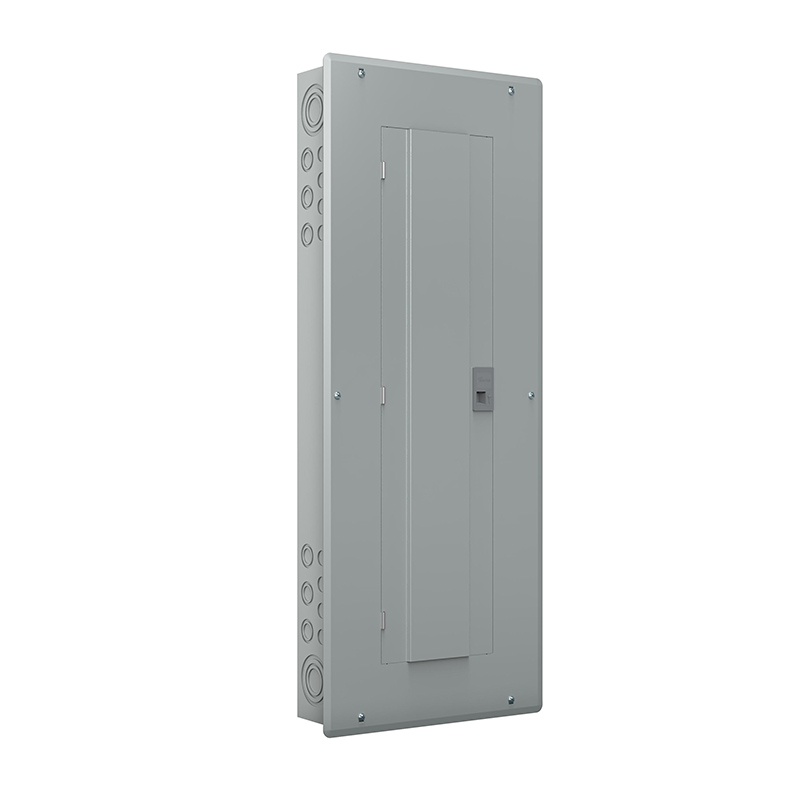
Load center vs. panelboard: a practical comparison
| Consideration | Typical load center | Commercial-style panelboard |
|---|---|---|
| Common use | Homes, apartments, and smaller distribution jobs | Commercial, institutional, and more complex distribution jobs |
| Configuration | Often standardized, compact layouts | Often broader options for circuit and bus arrangements |
| Voltage and current | Common residential ratings; model-specific limits | A wider range of ratings may be offered |
| Breakers | Often plug-in designs | Plug-in or bolt-on designs, depending on series |
| Enclosure | Usually compact | Size and construction vary with capacity and features |
| Project cost | Often economical for straightforward installations | Cost depends on capacity, components, and customization |
These are typical market differences rather than fixed rules. For example, it would be misleading to say that every load center is limited to 200A or that every panelboard is rated for 600V. Compare the ratings on the actual equipment rather than treating broad category descriptions as product limits.
Where a load center usually makes sense
For a typical house, townhouse, or apartment, a load center is often the simplest starting point. It can supply familiar residential branch circuits without introducing a more elaborate distribution assembly than the project needs. Load centers also appear in renovations, garage and workshop subpanels, and some smaller retail or service spaces.
A good selection starts with the calculated load, supply voltage, available fault current, and the number of circuits required. Check the panel’s available spaces, permitted breaker types, and room for future additions. A lower purchase price is not helpful if the chosen enclosure cannot accept the breakers or circuits the project requires.
When a panelboard may be the better choice
A commercial-style panelboard becomes attractive when the distribution system requires more circuit positions, different breaker frame options, metering, or other features not offered by the proposed load center. Office buildings, schools, healthcare facilities, and industrial sites often have these requirements. Larger buildings may use a panelboard for central distribution while smaller downstream load centers or panelboards serve individual areas.
The decision is not simply “residential versus commercial.” Some light commercial projects are adequately served by a listed load center, while a residence with unusual electrical requirements may justify a more configurable assembly. The one-line diagram and equipment schedule are more reliable guides than the building label alone.
What to check before ordering
When choosing a load center or panelboard, start with the electrical requirements of the project. Check the system voltage, phase, load requirements, bus and main ratings, and short-circuit current rating. Circuit breaker compatibility is also important, as breakers that fit into a panel may not be approved for use with that particular model.
Installation conditions can also influence the choice. Consider where the equipment will be mounted, whether it needs an indoor or outdoor enclosure, and how much space is available for wiring and maintenance. If the electrical system may need to accommodate additional circuits in the future, it’s worth allowing for extra capacity and spare breaker spaces when selecting the equipment.
Electrical codes and local regulations should also be considered. In Canada, equipment must meet applicable Canadian Electrical Code requirements and be approved for the intended installation. Projects in the United States must follow the relevant National Electrical Code (NEC) provisions and local requirements. Load calculations and installation should be carried out by qualified electrical professionals in accordance with local regulations.
METO Load Centers for Residential Applications
METO offers ReliaHome load centers for residential electrical distribution, including the MTSD and CH series. Depending on the model, available features may include plug-on-neutral designs and dedicated circuit breaker connection systems. Before placing an order, buyers should check the latest product specifications to confirm model availability, compatible breakers, and configuration options.
For distributors and electrical contractors, detailed product documentation is particularly important. Dimensional drawings, technical data sheets, and model-specific certification information help ensure that the selected load center meets the project’s electrical and installation requirements. Checking these details in advance can also prevent compatibility issues and unnecessary product substitutions. For further specifications, please contact the METO team.
Frequently asked questions
Is a load center the same thing as a panelboard?
A load center is generally a type of panelboard in North American terminology. In the marketplace, the two names often distinguish compact residential products from more configurable commercial assemblies.
Can a panelboard be installed in a home?
Yes, where its rating, listing, and installation requirements are suitable. A standard load center is often more economical for ordinary residential needs, but the right choice depends on the design.
Do commercial buildings always need panelboards?
Not necessarily. Smaller commercial spaces may use load centers when their electrical requirements and the product listing permit it. Larger or more complex systems often favor commercial-style panelboards.
Are bolt-on breakers always better than plug-in breakers?
No. The connection method is only one design characteristic. Use the breakers identified for the specific equipment and evaluate the assembly’s ratings and intended application.
What is a subpanel?
A subpanel is a downstream distribution panel supplied from other electrical equipment. Depending on the project, it may be a load center or another type of panelboard.
Does one type last longer?
Service life depends on component quality, loading, operating conditions, maintenance, and proper installation. The category name alone does not establish a longer life.

--- END ---
Prev: What Are Wiring Devices? Types, Uses and Buying Considerations
Already the latest article
In this blog
Latest Articles


Newsletter
Never miss an update by signing up to our newsletter.