

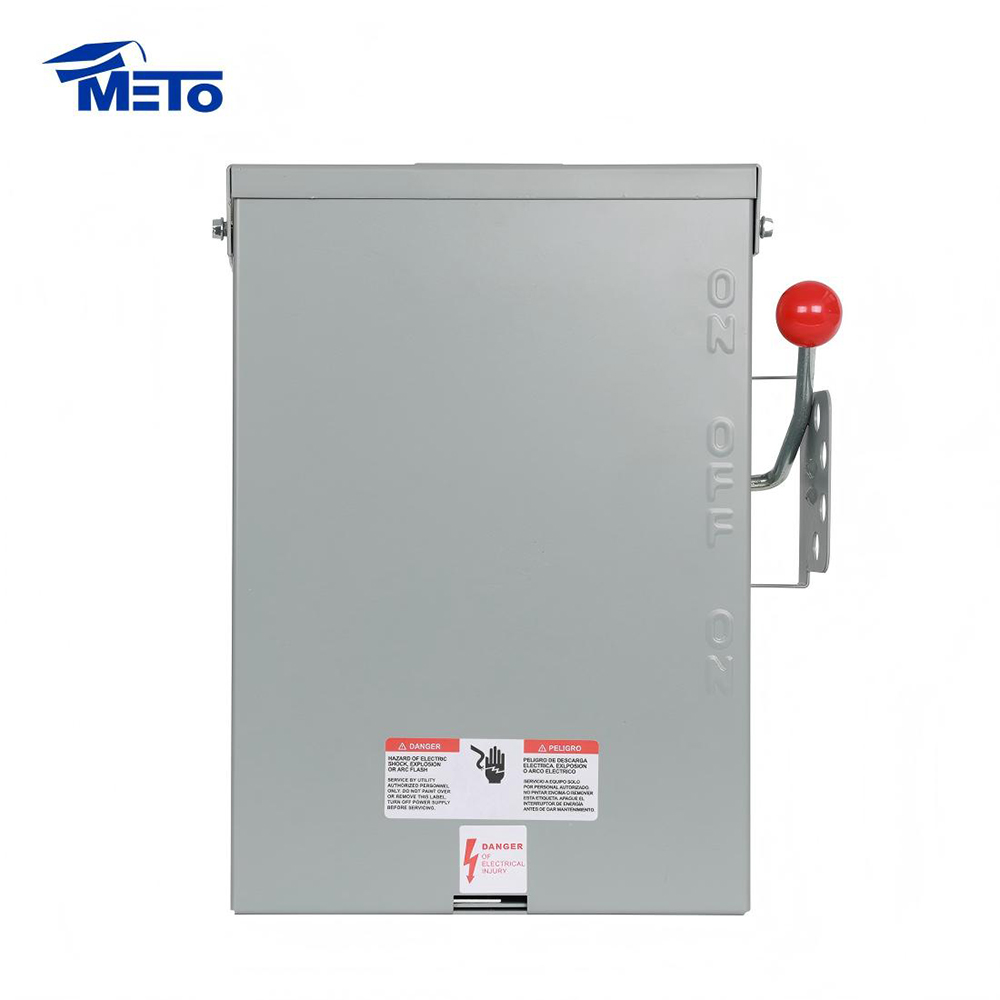
When technicians service a motor, air-conditioning unit, pump or other electrical equipment, they need a clear and accessible way to disconnect it from the power source. An enclosed safety switch provides this local point of control, with an external handle showing whether the circuit is ON or OFF.
The term “safety switch” can refer to different products in different markets. In this guide, it refers to the North American enclosed safety switch, a manually operated device used to disconnect electrical equipment or a circuit from its supply.
Safety switches are available in fusible and non-fusible designs. Fusible models can provide overcurrent protection when fitted with properly selected fuses. Non-fusible models provide the disconnecting function only and rely on an upstream protective device for overload and short-circuit protection.
In the United States, enclosed and dead-front switches are commonly evaluated under UL 98. Final product selection should also consider the switch ratings and markings, system design, installation instructions, applicable electrical codes, and requirements of the authority having jurisdiction (AHJ).
How Does a Safety Switch Work?
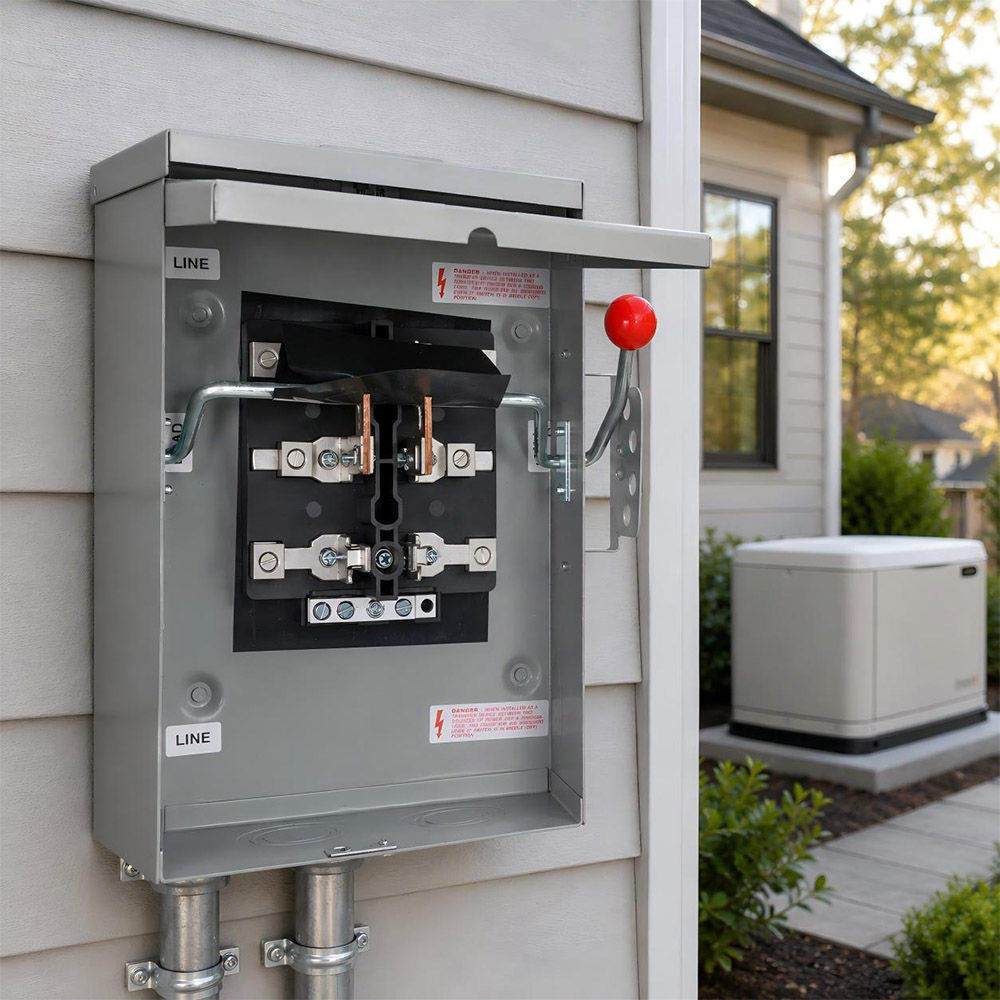
The operating handle is mechanically linked to internal contacts or blades. Moving the handle to ON closes the contacts so current can flow from the line terminals to the load terminals. Moving it to OFF opens the contacts and interrupts that path. Designs may use a quick-make, quick-break mechanism to complete switching rapidly and consistently.
- Enclosure: Helps prevent accidental contact with energized parts and protects the mechanism from the environment to the extent indicated by its enclosure rating.
- Operating handle: Provides external control and a visible position indication. Many models can accept a padlock in the OFF position for a site lockout/tagout procedure.
- Switching contacts or blades: Open and close the ungrounded conductors together as part of the disconnecting action.
- Line and load terminals: Provide the incoming supply and outgoing load connections. Installers must follow the marked wiring arrangement and torque instructions.
Fuse provisions, when included: Accept the specified fuse class and rating so the selected combination can provide overcurrent protection.
Cover interlock or viewing feature, when provided: Can discourage access while energized or offer an additional way to observe switch position.
Main Types of Safety Switches
Fusible and non-fusible safety switches
| Type | Primary function | Typical fit | Key consideration |
| Fusible | Switching and isolation plus space for approved fuses | Projects that need local disconnection and coordinated overcurrent protection | Requires the correct fuse class/rating and replacement after operation |
| Non‑fusible | Switching and isolation only | Circuits already protected by a properly selected upstream device | Does not provide automatic overcurrent protection |
General-duty and heavy-duty models
General-duty safety switches are commonly used in residential and light commercial applications where operating demands and environmental conditions are moderate. Heavy-duty switches are built for more demanding commercial and industrial service and are available in broader current, voltage, horsepower, and enclosure configurations.
“Heavy duty” is not a substitute for checking the nameplate: every application must be matched to the exact ratings of the selected model.
Single-throw and double-throw switches
A single-throw switch connects or disconnects one source from a load. A double-throw switch selects between two sources through a common connection. Double-throw equipment is used in some transfer and alternate-source applications, but it must be specifically evaluated and installed for the intended system; a standard single-throw disconnect is not a transfer switch.
Enclosure types
The enclosure must suit the installation environment.
Common Applications of Safety Switches
- Industrial machinery: A local, visible disconnect near motors, conveyors, pumps, compressors, and production equipment.
- HVAC systems: Isolation for outdoor condensers, rooftop units, air handlers, and other serviceable equipment.
- Commercial buildings: Disconnecting means for service equipment, feeders, signs, kitchens, and dedicated loads where the design calls for one.
- Water and wastewater facilities: Isolation for pumps, treatment equipment, and outdoor loads, using an enclosure suitable for the location.
- Renewable-energy systems: AC or DC disconnect functions for photovoltaic, energy-storage, or distributed-energy equipment when the switch is specifically rated for that duty.
- OEM and control-panel projects: Machine supply isolation and panel disconnecting functions, subject to the applicable product standard and machine design.
Why Safety Switches Matter for Electrical Safety and Maintenance
A properly selected safety switch provides a clear, accessible point for controlling power to electrical equipment. It can simplify maintenance and fault isolation, support emergency shutdown procedures, and provide a defined disconnecting point for lockout/tagout (LOTO).
The external handle also gives workers a visible indication of the switch position without opening the enclosure.
However, a safety switch is only one part of a complete electrical safety system. Safe operation also depends on proper system design, protective-device coordination, grounding and bonding, correct installation and labeling, worker training, appropriate PPE, and documented energy-control procedures.
How to Select the Right Safety Switch?
Start with the system—not the enclosure size. A procurement description should identify the electrical duty, environmental conditions, protection strategy, required approvals, and project-specific accessories.
Confirm voltage and current ratings. The marked voltage and ampere rating must be suitable for the circuit. Do not select only by physical size.
Match the number of poles and system conductors. Specify phase arrangement, poles, switched conductors, neutral requirements, and grounding provisions.
Check motor and load ratings. For motor applications, verify the horsepower rating and any application-specific load-break requirements.
Choose fusible or non-fusible construction. Use a fusible switch when the design calls for local fuses; use a non-fusible switch when overcurrent protection is provided elsewhere and only isolation is needed.
Verify short-circuit performance. Confirm the switch or fuse-switch combination, fuse class, upstream protection, and available fault current are compatible with the required short-circuit current rating (SCCR).
Select the enclosure for the location. Consider indoor or outdoor exposure, water, dust, washdown, corrosion, temperature, and hazardous-location classification. Confirm service-entrance suitability when relevant. Do not assume every safety switch can be used as service equipment; check the exact listing, labeling, neutral/ground provisions, and local requirements.
Review certification and market requirements. Specify the applicable product standard, third-party certification, markings, language, documentation, and destination-country requirements.
Evaluate operating and installation features. Consider padlocking provisions, visible indication, viewing windows, cover interlocks, terminal capacity, wire-bending space, mounting, auxiliary contacts, and shunt-trip options.
Key Safety Switch Installation and Operating Considerations
Safety switch installation, testing and servicing should only be carried out by qualified electrical personnel in accordance with applicable codes, manufacturer instructions and site safety procedures.
Before opening the enclosure, all power sources must be de-energized. This includes potential generator, photovoltaic, battery storage, control-power and backfeed sources. Installation should follow the product wiring diagram and specified requirements for line/load connections, conductor size, lug temperature ratings and terminal torque.
Working space and accessibility must also be maintained, along with proper grounding and bonding, enclosure integrity, and any required drainage or sealing provisions. Use only approved fuses, hubs, neutral and grounding kits, accessories and replacement parts specified for the exact switch model.
Before the circuit is returned to service, inspect the installation, reinstall all barriers and covers, verify correct handle operation, and complete the required electrical tests.
Safety Switch Maintenance Checklist
Maintenance frequency should follow the manufacturer’s instructions and the facility’s risk-based program. Environmental exposure, switching frequency, load conditions, and previous faults can justify more frequent inspection.
Inspect the enclosure, hinges, latches, gasket, conduit entries, labels, and lockout provisions.
Look for water ingress, dust buildup, corrosion, discoloration, loose parts, or evidence of overheating.
With the equipment safely isolated, check terminals and conductors as directed by the manufacturer; do not re-torque energized connections.
Operate and examine the mechanism according to the maintenance instructions; confirm a positive ON/OFF indication.
For fusible models, verify that fuse class and ratings match the approved design. Investigate the cause before replacing an operated fuse.
Document findings and correct damaged components, compromised enclosures, unreadable labels, and abnormal thermal or electrical test results.
Conclusion
Selecting the right safety switch involves more than matching the current rating. Key factors include fusible or non-fusible design, voltage, number of poles, motor horsepower, SCCR, enclosure type, line-side requirements, certifications and lockout provisions.
For distributors, contractors, OEMs, utilities and project buyers, METO can help identify suitable safety switch options based on your application. For a more accurate recommendation, provide your system voltage and current, number of poles, fuse requirements, motor rating, enclosure type, required certifications and order quantity.
Contact METO with your project specifications, and our team will help you select the right safety switch for your application.


